
Why Certelo Chose Electra Protocol for Privacy-First Document Timestamping
Every creator, developer, and business eventually runs into the same problem: how do you prove a piece of work existed at a specific moment in time, without handing that work over to a third party first? A songwriter doesn’t want to upload an unreleased track to a public server. A law firm can’t paste a client contract into some random web form. A developer building a proprietary algorithm isn’t going to email the source code to a “trusted” registry and hope for the best.
This is the exact gap that blockchain timestamping was built to close, and it’s why Certelo built its proof-of-existence engine on Electra Protocol rather than a slower, costlier, or more centralized chain.
The Problem With Most “Proof” Services
Traditional ways of proving document authenticity notarization, registered mail, third-party escrow all share the same weakness. They rely on a single institution to vouch for the truth. If that institution loses records, changes its policies, or simply stops existing, the proof goes with it. Digital versions of the same idea (timestamp authorities operated by one company) inherit the same risk: centralized trust is a single point of failure.
A blockchain-anchored timestamp solves this differently. Once a record is written to a public, decentralized ledger, no single company controls whether that record stays valid. That’s the whole point of decentralization, and it’s the reason Certelo doesn’t build its own private chain or lean on a closed, permissioned network for something as important as legal evidence.
What Electra Protocol Brings to the Table
Electra Protocol is a layer-1, proof-of-stake blockchain that was launched by a global community of volunteers rather than a single company, with no initial coin offering behind it. For a timestamping and proof-of-existence platform, that matters more than it might seem at first glance.
A few things stand out specifically for this use case:
- Independent verifiability. Because Electra Protocol is public and permissionless, anyone — a court, an auditor, an opposing party in a dispute can verify a record on the chain without needing Certelo’s cooperation or trusting Certelo’s word for it.
- Low-cost, fast confirmation. Timestamping only works at scale if it’s affordable per document. A platform charging near-zero transaction costs for near-instant confirmation makes it realistic to timestamp drafts, revisions, and working files, not just final deliverables.
- No central operator to depend on. With no company controlling issuance or governance, there’s no single party that can quietly change the rules, restrict access, or shut the network down.
These properties are exactly what turn a blockchain from a buzzword into a genuinely useful piece of legal and compliance infrastructure.
How the Privacy-First Part Actually Works
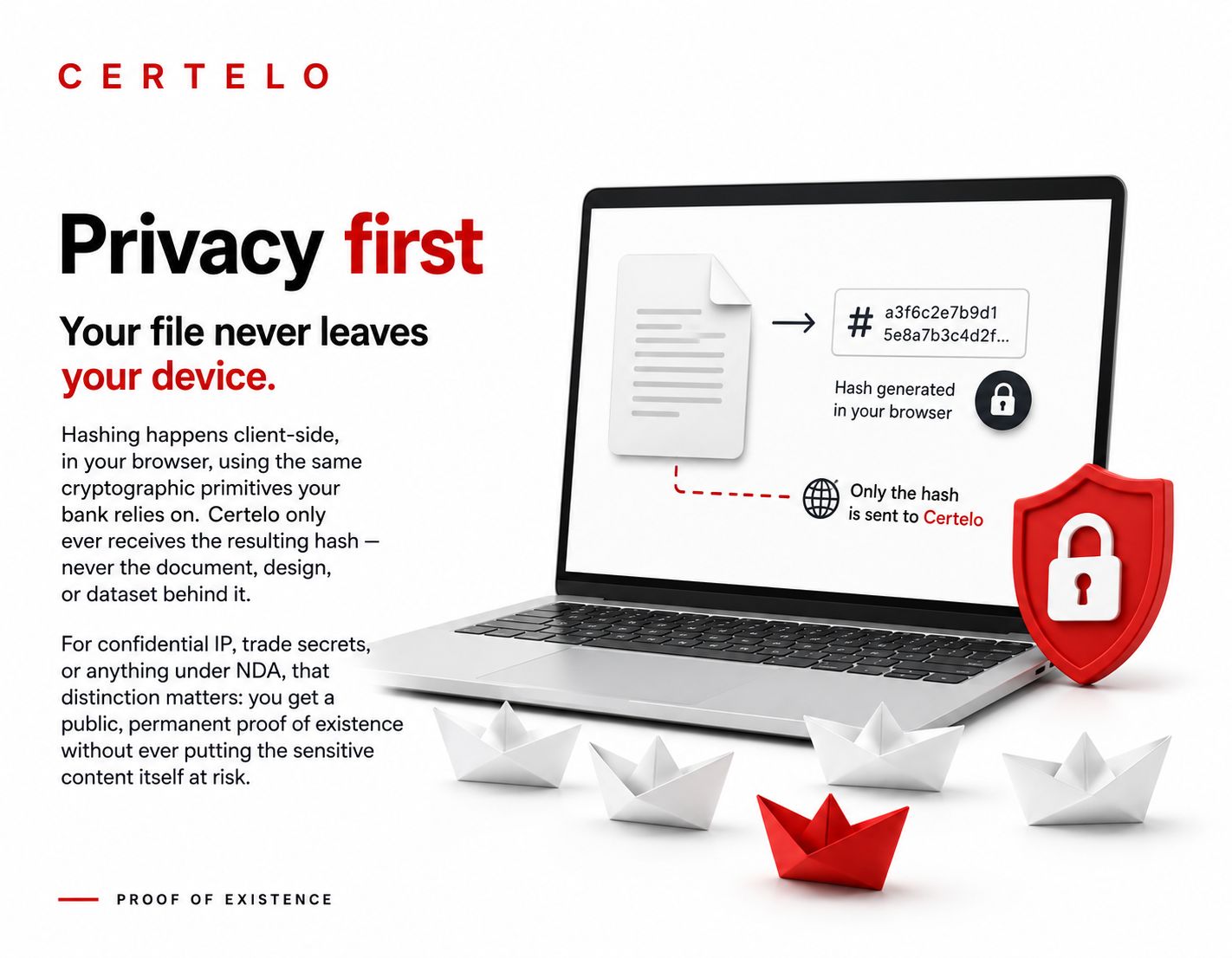
Here’s the detail that surprises people the first time they hear it: Certelo never uploads the actual document to Electra Protocol, or to anyone else.
Instead, the platform runs the file a PDF contract, a design file, a piece of source code, an audio draft through the SHA-256 hashing algorithm. That produces a unique digital fingerprint, a string of characters that represents the file’s exact content but reveals nothing about what’s inside it. Change a single comma in the document, and the fingerprint changes completely. That fingerprint, not the file itself, is what gets anchored to Electra Protocol’s ledger.
This is what makes the whole approach privacy-first in a real sense, not just a marketing line. A freelancer can timestamp a confidential client deliverable before sending it over. A company can date-stamp an internal compliance document without exposing its contents to a public network. An inventor can prove a design existed on a given date without publishing the design itself. The blockchain record becomes tamper-evident proof of existence, hashing and verification without ever functioning as a public leak.
Where This Shows Up in Practice
The use cases stack up quickly once the underlying mechanism is in place:
Code ownership. A developer working on proprietary logic can timestamp source code files at each meaningful milestone. If a dispute over authorship or IP theft ever surfaces, there’s an immutable file hash verification trail showing exactly when each version existed a far stronger position than relying on file metadata or git history alone, both of which can be altered.
Legal and compliance documents. Contracts, board resolutions, and audit-sensitive records benefit from a timestamp PDF for legal proof that stands independent of any one vendor’s servers. For regulated industries, that independence is often the difference between evidence that holds up and evidence that gets challenged.
Insurance and pre-loss documentation. Insurers and policyholders increasingly use pre-loss document timestamping to establish the condition of property, inventory, or assets before a claim is ever filed a secure timestamp API call at intake, rather than a scramble for proof after the fact.
Creative work. Musicians, designers, and writers use the same mechanism to establish proof of prior existence for creative work, which matters enormously in copyright disputes and plagiarism claims where the question isn’t “did you create this” but “who created it first.”
Verification Doesn’t Require Trusting Certelo
This is worth spelling out directly: verification of a Certelo timestamp doesn’t depend on Certelo staying in business, keeping good records, or acting in good faith. Anyone can independently recompute a file’s hash and check it against the record anchored on Electra Protocol’s public ledger. That’s a meaningfully different guarantee than a service that simply logs “we saw this file on this date” in its own private database.
A Few Common Questions
Does Certelo store my files on the blockchain? No. Only the cryptographic hash the file’s digital fingerprint is anchored to Electra Protocol. The original document never leaves your control.
Can a blockchain timestamp really hold up as legal evidence? Courts and auditors increasingly accept cryptographic timestamps as evidence of prior existence, particularly when the underlying chain is public, decentralized, and independently verifiable all of which apply here.
Why anchor to Electra Protocol instead of a private ledger? A private or permissioned ledger reintroduces the single point of failure that blockchain timestamping is meant to eliminate. A public, decentralized network like Electra Protocol removes any one party’s ability to alter or dispute the record.
Proof of existence isn’t a new idea people have been notarizing documents for centuries. What’s changed is the infrastructure underneath it. Pairing SHA-256 hashing with a decentralized, low-cost, community-run chain like Electra Protocol gives creators, developers, and businesses a way to prove when something existed without giving up control of what it is. That combination is what Certelo, a blockchain-based proof-of-existence and document timestamping platform, is built around.