
Electra Protocol: Evolving Beyond Cryptocurrency
Over the years, Electra Protocol has continued to evolve, with development extending far beyond its original cryptocurrency-focused identity.
Today, we believe it is time to share more about the direction we are exploring for the future of Electra Protocol, and how the technology we have built can support a much broader range of applications.
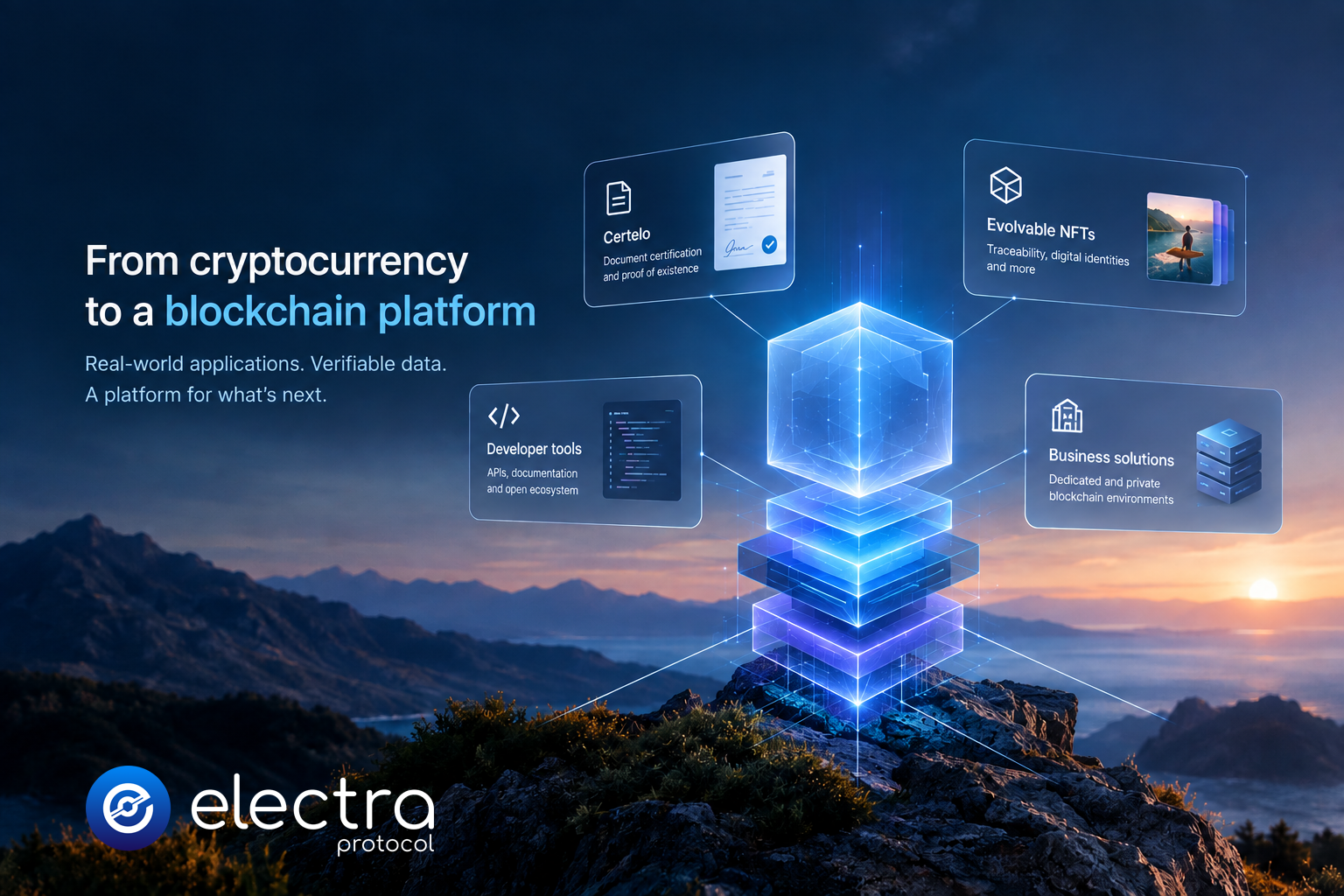
Electra Protocol is evolving toward a public Blockchain platform designed to help individuals, developers, and organizations build, verify, and manage digital data.
This is not a departure from our origins. It is a continuation of the work that has been carried out over the years, building on our existing infrastructure, open-source foundations, and technical capabilities.
From a cryptocurrency project to a Blockchain platform
When Electra Protocol first emerged, its public identity was primarily associated with cryptocurrency, token-related activity, and the broader crypto ecosystem.
While these elements remain part of our history and ecosystem, they no longer fully represent what the technology has become.
The Electra Blockchain and its surrounding infrastructure have continued to develop, including the OmniXEP smart contract layer, wallet infrastructure, APIs, and other supporting components.
Our objective is to make these capabilities more accessible and useful for projects that go beyond traditional cryptocurrency applications.
In this vision, XEP remains an integral part of the ecosystem, serving as the fuel that powers operations on the network, while the platform’s broader capabilities become a central focus.
The goal is to demonstrate what can be built with the technology, rather than limiting the public perception of Electra Protocol to its currency.
Certelo: A first real-world application
One of the first live examples of a product built using the Electra Protocol is Certelo, a document certification service developed by Evoblox.
Certelo allows users to generate a cryptographic fingerprint of a digital document locally, directly in their browser or through a terminal command. The resulting hash is recorded on the Blockchain, creating a verifiable record associated with a specific point in time.
The original document does not need to be uploaded to the service for the hashing process, allowing users to retain control of their files.
This type of application illustrates how Blockchain technology can be used for practical digital verification, without requiring users to interact with a traditional cryptocurrency exchange or manage complex Blockchain infrastructure.
Certelo is just one example of what can be developed using Electra Protocol. Our ambition is to make it possible for other developers and organizations to explore similar opportunities.
Unlocking the potential of OmniXEP
OmniXEP is an important component of the Electra ecosystem, providing capabilities that can support applications involving structured, verifiable, and evolving digital data.
One area of interest is the use of evolvable NFTs.
Unlike a static digital asset, an evolvable NFT can be designed to accommodate additional information over time. This opens the door to applications where an asset, product, or entity needs to maintain a record of changes throughout its lifecycle.
Potential use cases include:
- Product traceability: Recording production, delivery, and ownership-related events.
- Digital identities: Exploring ways to associate unique identities with digital systems while limiting the disclosure of personal information.
- Data relationships: Establishing verifiable associations between different digital entities.
- Lifecycle management: Maintaining a structured record of events associated with a product or asset.
These are examples of possible applications, not a declaration that every use case is currently available as a production-ready service.
The underlying capabilities offer opportunities to explore applications in areas where data integrity, traceability, and auditability are important.
Exploring dedicated and private Blockchain environments
Another area of development under consideration is the possibility of offering dedicated OmniXEP environments to organizations and businesses.
A white-label approach could allow a company or project to deploy its own environment, supported by components such as a wallet, block explorer, indexer, and API.
This type of offering could make Blockchain infrastructure more accessible to organizations that want to build their own applications without developing every underlying component from scratch.
We are also exploring the potential of private, encrypted layers for use cases where data integrity and Blockchain-based verification are important, but where the underlying information should not be publicly readable.
In such a model, data could be encrypted before being written to the Blockchain, allowing authorized parties to access the information while preserving the integrity properties of the underlying network.
These concepts remain areas of investigation and further development. Their technical implementation, availability, and use cases will need to be evaluated before any formal offering is announced.
Building an ecosystem for developers and businesses
A major part of the future direction is making Electra Protocol easier to understand and use for developers and organizations.
We want to move toward a platform where technical documentation, accessible tools, and practical examples make it easier for external teams to explore what can be built on the network.
This includes plans to improve developer resources and documentation, as well as investigating API access that could allow third-party applications to interact with Electra Protocol programmatically.
Over time, this could enable a wider range of products and services to use the network without depending on Electra’s own internal development teams for every application.
We believe an open platform model can create opportunities for developers and organizations working in different industries, each with their own requirements and ideas.
The next stage for Electra Protocol
This evolution will involve more than a change to our website or communication style.
It represents an effort to align the public presentation of Electra Protocol with the technology that has been developed and the applications we want to enable in the future.
The next steps will include further work on our platform narrative, website structure, developer resources, and communication strategy.
We also want to ensure that this transition is handled progressively, with the existing community kept informed as the direction develops.
Electra Protocol’s history, open-source foundations, and existing ecosystem remain part of this journey. Our objective is to build on that foundation while opening the door to new types of users, developers, and applications.
The future of Electra Protocol is not limited to what a Blockchain token can represent. It is also about what people and organizations can build with the technology behind it.
We look forward to sharing more about this direction and the next stages of development in the coming months.
Building the infrastructure for verifiable digital data.